
Project Portfolio Management
PPM is managing programs, projects, and operations as a strategic portfolio in order to ensure alignment with university strategies and objectives.
Why is time collection via Planview important for PPM?
Data collected from the Planview timesheets and project plans is used by Washington University IT Management to improve service delivery by allocating resources to support strategic goals. PPM supports IT Strategic Governance through planning and measuring results—a key IT organizational capability.
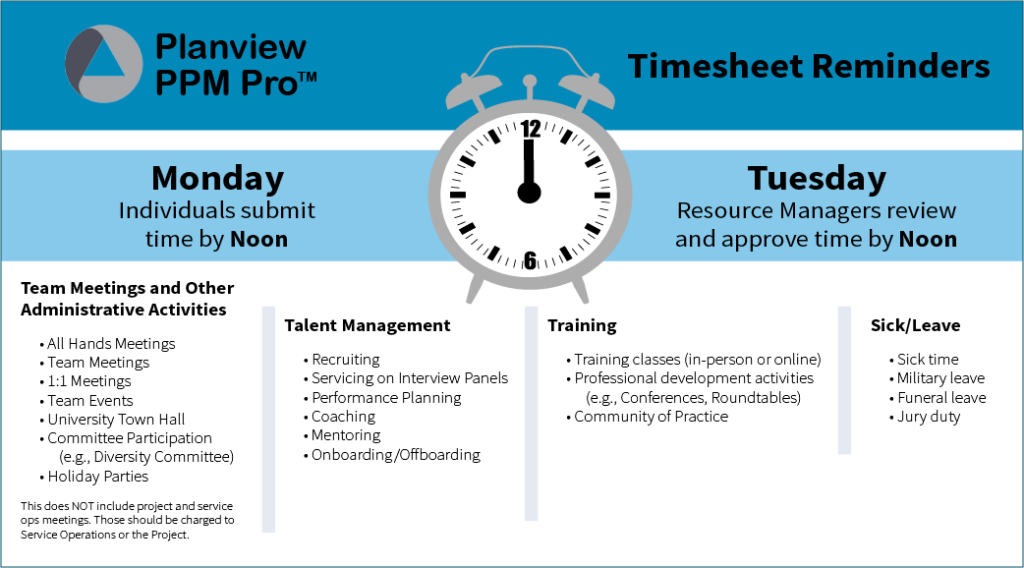
Learning Resources
Time Entry and Approval
WUIT – Planview Time Entry (MP4 Micro Tutorial 3:55)
Planview Time Entry (User Guide PDF)
WUIT – Planview Mobile Time Entry – (Workday Learning Course)
Future Timesheet Submission (User Guide PDF)
WUIT – Planview Mobile Time Entry Approvals Overview (Workday Learning Course)
Timesheet Approval Includes steps to approve via Desktop and Mobile (User Guide PDF)
Alternate Timesheet Approvers (User Guide PDF)
Learn about your Planview Home Overview Dashboard and how to access your Timesheet (Quick Guide PDF) or Planview Home Overview Page (MP4 Micro Tutorial 1:45)
Get Help
Planview Administrative Requests Request to consult with a Planview administrator for resource updates or modifications, timesheet requests, changes to resource records or access to Sandbox.
Request for New or Modified Planview Access Request to obtain new licensed access or modify existing licensed access to Planview in order to enter time, approve time, enter and manage project details. Or change from Time User to Full User.
Request to remove access from Planview
If you need further assistance regarding Planview, contact: ppmo@wustl.edu
Reporting in Planview
Explore our selection of popular Planview reports, complete with detailed descriptions and how-to documentation (when available).
Quick Links
Planview Quick Guides & Micro Learnings (Box Hub) Direct access to files that include:
- Time User & Approver User Guides
- Project & Service Ops User Guides
- Reports & Reporting
- Other Helpful User Guides & Tips
- Micro Learning Videos
PM Guide (Confluence) Log in Note: Bypass the ‘no access’ warning and log in using the icon in top right corner. Example of login page (PNG).



Reference
Project: Creating a unique product, service or feature (time-limited). Projects also satisfy at least one of the following criteria:
- New application or vendor-hosted solution
- High volume request – a higher level than typical business operations
- Examples:
- Replace white box workstations at the law school (100 plus units)
- Windows 7 workstation replacements across campus
- Significant storage upgrade for the internal cloud (25-50 devices)
- Examples:
- Opening a new facility
- High Risk – mission-critical change; high/broad impact
- Work that requires high visibility by senior leadership for tracking progress, issues, risks, costs, etc.
- Origin: IT Strategic Governance
- New service or service offering related to an existing service
Once a project has been approved and funded, you may request that the project be entered into Planview for management and time entry. You will request approved and funded projects through the Requests tab within Planview.
Service Operations Activities: The day-to-day activities around management of an IT Service or System, as well as short-term enhancements to keep them relevant.
- Service Operations Activities will be managed in the Planview system. Within a Service Operations Activity in Planview, there will be broad, year-long tasks, such as Run/Fix tasks (e.g., service desk, monitoring, provisioning, etc.) and Enhance tasks. The naming of the tasks, as well as the task breakdown structure is at the discretion of the Resource Manager.
- Resource Managers will serve as Project Managers in Planview for their area’s Service Operations.
Each individual in the Planview system is assigned a primary “role” referring to the primary skills set the individual uses to perform work. Note that an individual’s role for capacity planning is not the same as the HR job title. Summarizing the roles across the IT organization allows for forecasting capacity and demand across portfolios of work.
- A/V Specialist
- Administrative Coordinator
- App Developer I&II
- App Developer III&Lead
- Application Admin
- Application Analyst I & II
- Application Analyst III & Lead
- Apprentice
- Architect
- Asset Manager
- Business Alignment
- Business Analyst I, II & III
- Business Analyst IV & Lead
- Change Lead
- Change Management Specialist
- Change Manager
- Communications Coordinator
- Communications Lead
- Communications Specialist I & II
- Communications Strategist
- Customer Relationship Manager
- Database Administrator
- Datacenter Technician
- Desktop Engineer I & II
- Desktop Support
- Executive Director
- HPC Hardware Specialist II
- HPC Hardware Specialist III
- HPC Research Facilitator
- Info Security Specialist
- Intern
- IT Administrator
- IT Portfolio Analyst
- ITSM Analyst
- Learning and Development Specialists
- Management
- Manager
- Network Analyst
- Network Architect
- Network Engineer
- Network System Administrator
- Network Technician (Layer 1)
- NOC Analyst
- Program Director
- Program Manager
- Project Coordinator
- Project Director
- Project Manager I & II
- Project Manager III & Senior PM
- Project Manager Lead
- Quality Assurance Analyst I & II
- Quality Assurance Analyst Lead
- Security Analyst
- Senior Desktop Technician
- Senior Technical Support Specialist
- Service Delivery Lead
- Service Desk
- Student Worker
- Supervisor
- Systems Analyst
- Systems Engineer I & II
- Systems Engineer III & IV
- Technical Support Specialist I & II
- Technical Support Specialist III
- Technical Writer
- Telecom Analyst
- Trainer
- Training Lead
- Vendor Management
Frequently Asked Questions
Why can’t I log in to Planview?
- Check the URL.
- Go to wustl.ppmpro.com. You should see the WUSTL connect page to log in. (Note: do not go to www.innotas.com to log in)…
Why do I have to enter my time in both Workday and Planview?
You enter time in Workday for the purposes of payroll, but this system is not set up to give IT leadership a clear picture of how IT labor hours are being used. For example…
What are the Planview Timesheet Guidelines?
- Enter time to the nearest half-hour.
- Enter the actual amount worked, even if it goes over your standard work week…
Requests/Questions
Please submit this ServiceNow request form.
Communications
The Capacity Management Corner: New Resources Announcement
The Capacity Management Corner: Allocations for Capacity Management
The Capacity Management Corner: Multiplier and Allocation Changes Implemented
May 20: New and Renamed Planview Fields
If you have any questions regarding Planview, contact ppmo@wustl.edu.