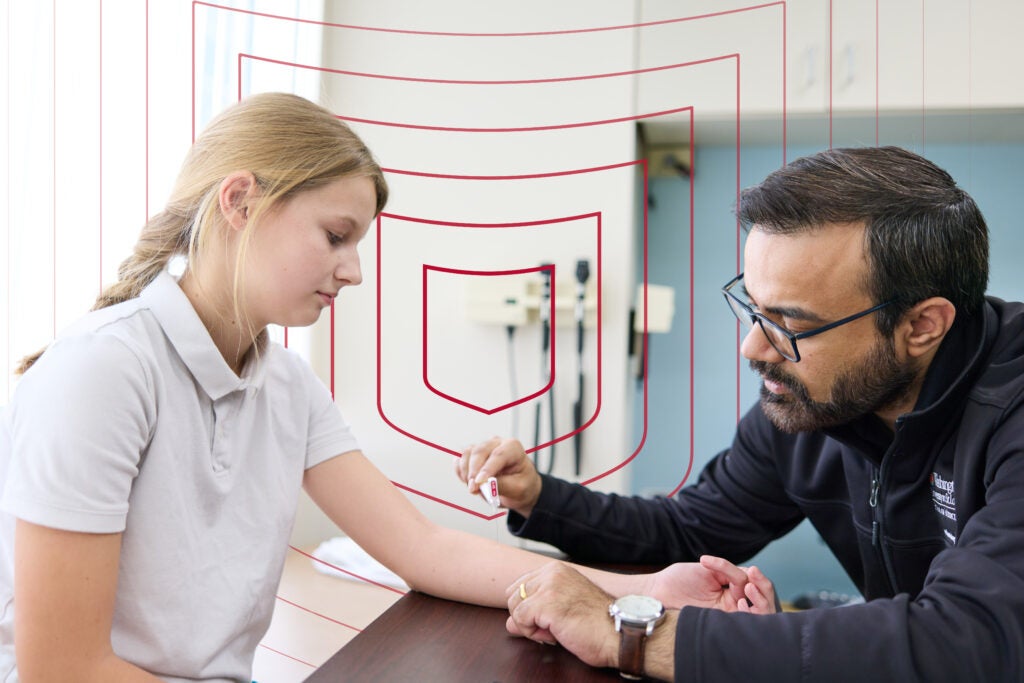
At BJC HealthCare and the WashU School of Medicine, AI is changing what a typical day looks like for doctors, nurses and care teams. The goal is simple: less time on the computer; more time with patients.
Leaders from the Epic1 team, which manages the shared BJC/WashU Epic electronic medical record system, recently shared how new AI features are taking some of the busy work off clinicians’ plates so they can focus on listening, explaining and caring.
As Richard Biehl, Senior Director of Application and Product Delivery, put it, “It’s saving time and helping providers get back to spending time with their patients instead of their keyboards.”
Listening, so doctors can look at their patients—not their screens
One of the biggest recent AI-related changes comes from a partnership with Abridge, a tool that “listens in” during a visit, with patient permission, and helps write a draft note the doctor needs to complete afterward.
Here’s how it works in a typical appointment:
· A clinician uses Abridge on their cell phone.
· The tool securely records the conversation and can identify who is speaking.
· A draft of the visit note is generated in real time, tailored to the type of visit and specialty.
Instead of typing every detail, a health care provider can review and edit the draft. Abridge supports more than 50 types of medical specialties and 28 languages, and it is starting to be used not only in clinics, but also in the hospital inpatient units and emergency departments.
Since Abridge rolled out more widely this year, Abridge has reported an 85% content retention from the Abridge drafted note. This correlates to dramatically less time clinicians spend on drafting their note —by an estimated 85%. That means less “homework” after a long day of seeing patients.
“Physicians aren’t pre-charting the night before or finishing notes at 10 p.m. at home anymore,” Biehl said. “They’re getting that time back—with their families or just to recharge.”
Faster, clearer replies to MyChart messages
More patients than ever are using MyChart to send questions and updates to practitioners. Across the system, clinicians now receive more than 5 million messages each year—and that number keeps rising.
To help manage this, BJC and WashU adopted Epic’s Augmented Response Technology (ART), which uses AI to suggest replies to patient messages.
Here’s what that looks like behind the scenes:
· ART reads the incoming MyChart message.
· It looks at relevant parts of the medical record.
· It creates a draft response for the clinician to review.
It is important to note that the AI never sends messages directly to patients. The physician or another member of a patient’s care team always reviews, edits or discards the draft before anything is sent.
“There is no automation without clinician approval,” said Michael Kriemelman, Senior Director of Application and Product Delivery. “That’s incredibly important.”
Since ART’s expansion to all outpatient providers earlier this year:
· About 95% of patient messages are answered within half a day.
· Thousands of draft replies are created each month.
· Early feedback from clinicians shows about 70% are satisfied with how it helps.
The result for patients: quicker answers and clearer explanations. The result for providers: less inbox overload and more energy for in-person care.
Making care better on both sides of the exam room
Together, these tools are changing the care experience:
For patients:
· More face-to-face time in the exam room.
· Faster responses to MyChart questions.
· Easier communication, including in many different languages.
For providers:
· Fewer late nights finishing charts and messages.
· Potential for less burnout and mental fatigue.
· More time and attention available for making complex medical decisions.
· Less typing, providing more freedom to focus on listening, explaining and connecting.
“We’re not taking thinking away from physicians,” Kriemelman said. “We’re giving them space to think about the right things—about their patients—rather than how to navigate the computer.”
Looking ahead
Abridge and ART are just the start. Epic’s future AI tools may help with hospital summaries, nursing notes, billing and other behind-the-scenes work, all with the same purpose—to simplify routine tasks so care teams can focus on people.
“This work doesn’t happen in isolation,” Biehl said. “It takes a village to make this possible. And the end result is better care for our patients and a better experience for our providers.”
As AI continues to grow, BJC and WashU leaders are committed to using it carefully and thoughtfully—always keeping clinicians in control and patients at the center.